

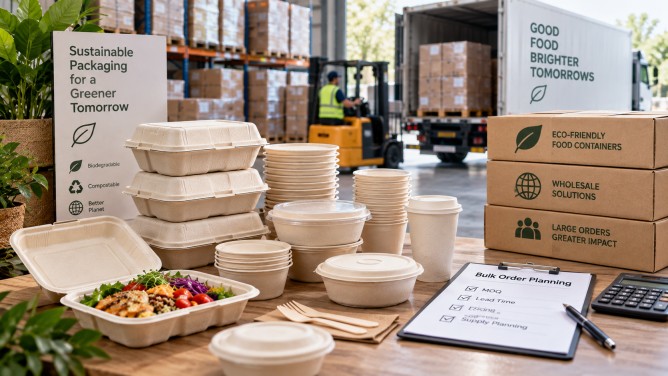
Wholesale purchasing of biodegradable food containers, such as those made from sugarcane bagasse, demands a distinct approach compared to small retail packs. Key considerations for distributors, restaurant groups, caterers, and private-label buyers include understanding minimum order quantities (MOQ), production lead times, pricing, container loading, shipping efficiency, and ensuring supply continuity. Grizzlies, a direct-from-factory manufacturer, offers a solution with standard sugarcane bagasse food containers, mixed-SKU container loading, and OEM/ODM customization across its 11 manufacturing bases. This helps buyers streamline their purchasing process by first aligning the container format with their menu and planning orders based on realistic consumption and logistics needs.
The concept of MOQ is critical, with no standard minimum across the board for biodegradable food containers. The requirements can vary depending on SKU, mold availability, customization needs, and production schedules. For those entering new markets, starting with standard molds can reduce tooling costs and ease initial production. As demand solidifies, buyers can opt for specialized structures and branding at higher volumes. Standard molded-fiber products typically have a production lead time of 20 to 30 days post order confirmation and specifications approval. Buyers are advised to plan 45 to 60 days ahead of major seasonal demands to secure production capacity and mitigate supply interruptions. Grizzlies’ factory in Thailand further enhances sourcing flexibility, particularly for international buyers in Southeast Asia.
Pricing for factory-direct purchases is influenced by several factors, including fiber usage, product complexity, mold requirements, barrier materials, and shipping efficiency. International buyers should note that the lowest unit price may not equate to the lowest landed cost, as carton dimensions, container loading quantities, and freight utilization impact the cost per container. A 40-foot High Cube container can hold multiple standard bagasse food container sizes, enabling distributors to diversify their product range without overcommitting to a single SKU. A well-planned mixed-SKU order should account for monthly consumption, fast-moving SKUs, carton dimensions, and available space for secondary SKUs to optimize manufacturing efficiency.
For ongoing wholesale programs, implementing a three-month rolling forecast is recommended over waiting until inventory is nearly depleted. Reorder timing should consider average monthly consumption, production time, ocean transit, customs clearance, and safety stock. For instance, a distributor using 60,000 containers monthly should plan replenishment before stock levels fall to a month’s supply. Providing comprehensive information at the quotation stage—such as product type, estimated consumption, preferred fiber color, and market-specific compliance requirements—enables manufacturers to suggest appropriate structures, confirm MOQ, estimate container loading, and provide realistic production timelines.
Direct sourcing from Grizzlies allows buyers greater control over product specifications, customization, quality control, and production scheduling. With over 15 years of experience in OEM/ODM manufacturing, Grizzlies supports wholesale, custom, and private-label programs, offering capabilities in custom molds, embossing, barrier structures, and detailed production planning. Businesses planning new wholesale programs can benefit from Grizzlies’ expertise by providing target SKUs, expected quantities, and destination markets, facilitating the evaluation of MOQs, samples, and factory-direct pricing.
Legal Disclaimer:
The information contained in this article has been provided by independent third-party contributors, clients, or content partners. We do not independently verify the accuracy, completeness, legality, ownership, licensing, or reliability of submitted content, including text, images, videos, trademarks, or other media materials. The submitting party is solely responsible for ensuring that all content, including images and media assets, complies with applicable copyright, trademark, licensing, and intellectual property laws. We disclaim liability for any unauthorized use of copyrighted or proprietary materials by third parties. If you believe that any content published on this platform infringes your intellectual property rights, kindly contact the author above for prompt review and resolution.